

Most "best of" lists for audit software are written by people who have never actually sat through a supplier audit that went sideways. This one is different.
Quality managers at food manufacturers, contract packagers, nutraceutical companies, and specialty chemical producers tend to describe the same situation. Audits are piling up. The audit schedule lives in someone's head or in a shared spreadsheet that three people have edited and nobody fully trusts. Non-conformances get logged, assigned, and then quietly forgotten until a customer asks about closure six weeks later. And when a third-party auditor shows up, the team spends two frantic days pulling records that should have been two clicks away.
The solution is straightforward. An internal audit management system that aligns with how your quality team actually works. The challenge lies in finding the right one. That is exactly what this guide covers: a transparent, feature-by-feature review of the top internal audit management software platforms, including their core capabilities, ideal use cases, and the types of operations each one is genuinely built for.
What is Internal Audit Management Software?
Internal audit management software is a digital system used to plan, conduct, and track internal audits within an organization.
It helps quality teams schedule audits, use standardized checklists, record findings, track non-conformances, and manage corrective and preventive actions (CAPA) from a single platform.
What Separates Good Internal Audit Management Software
Before the list, let me explain what everyone actually looks for when evaluating these platforms, because most comparison articles use the same five generic criteria that don't mean anything in practice.
Audit scheduling that sticks. This does not simply mean a calendar. It means a system that sends automated reminders to your auditors before the audit date, tracks who's acknowledged the schedule, and flags upcoming audits that haven't had a lead auditor assigned. Most tools have a calendar. Very few have the follow-through logic that keeps your annual audit program on track without someone manually herding it.
Checklists that don't fight you. Basic checklists rarely work well for manufacturers. Sanitizing the warehouse feels different from checking packaging or vetting suppliers. The tool should let teams make, save, and reuse templates, no developer needed.
NCR to CAPA, without the gap. This is where most tools fall down. They're fine at capturing findings. But converting a non-conformance record into a CAPA with an assigned owner, a root cause investigation, a due date, and an escalation path requires a tighter integration than most platforms actually deliver. The NCR and CAPA modules in many systems feel like they were built by different teams and connected with duct tape.
Reporting that informs rather than just outputs. Exporting the audit report as a PDF is a feature. However, a trend chart showing the three main finding categories recurring over a dozen audit months will be an insight. The best auditing application is the factor that makes them clear to any person who just looks at the dashboard.
Usability for the people who actually run audits. Your lead auditor is probably not a power user of enterprise software. If a platform requires two hours of training before someone can complete their first audit, adoption will suffer, and the data coming back will be incomplete and inconsistent.
Top Internal Audit Management Software Platforms in 2026
QualSmart.ai

QualSmart.ai is this list where it started deliberately, not just because of its features, but because the audit management module was designed around the exact frustrations as just described, and it shows in how it actually performs for quality teams.
The audit scheduling experience is probably the most intuitive of anything that has been seen in this space for mid-size to large-size manufacturers. You can set up a full annual internal audit schedule across departments, processes, or facilities in under an hour. Recurring audit series, one-off supplier audits, and unannounced spot-checks all live in the same calendar. Automated reminders go out to auditors and auditees at configurable lead times, and the system tracks completion rates without anyone needing to chase anyone.
What genuinely differentiates QualSmart.ai from every competitor in this segment is the AI-assisted checklist generation. When you set up an audit, the system uses your facility type, audit scope, and historical audit data to suggest relevant checklist items, which you can accept, modify, or discard. For quality managers who run multiple audit types across multiple product lines, this eliminates a serious amount of repetitive setup work and ensures you're not missing coverage areas that got overlooked in last year's template.
The non-conformance and CAPA integration is tight. Every finding raised during an audit generates a linked NCR directly. You assign an owner, set a due date, classify severity, and the CAPA workflow opens from the same record. There's no manual copying of information between modules. Managers have a live dashboard showing all open NCRs across all audits, colour-coded by status and overdue flag. That visibility alone is worth the switch from spreadsheets.
Supplier audits can also be managed within the same system. That helps makers who work with outside suppliers, mostly now when quality reviews cover almost every part of a process.
ETQ Reliance
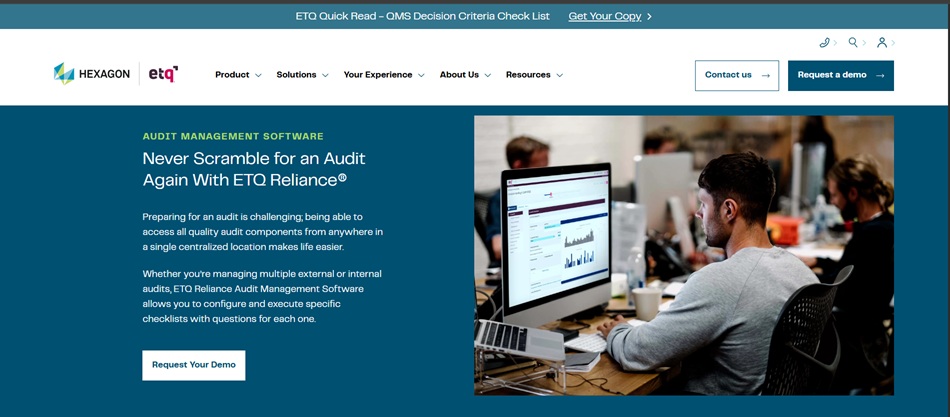
ETQ is the established enterprise name in this category, and it has earned that position. For large, complex, multi-site manufacturers with a dedicated quality IT function, ETQ Reliance delivers genuine depth.
The audit module supports sophisticated workflow configurations, multi-tiered audit approvals, cross-site scheduling, role-specific views, and integration across the broader QMS suite including CAPA, supplier management, and document control. The reporting capabilities at the enterprise level are among the best available. If you need to roll up audit performance data across eight facilities in four countries and present it to a board-level quality committee, ETQ handles that cleanly.
The honest trade-off: all of that capability comes with significant implementation investment. ETQ implementations are typically measured in months, not weeks. The system requires configuration by someone who understands both the platform and your quality process in depth, and it shows in the per-seat pricing, which is positioned firmly at the enterprise end of the market.
SafetyCulture (iAuditor)
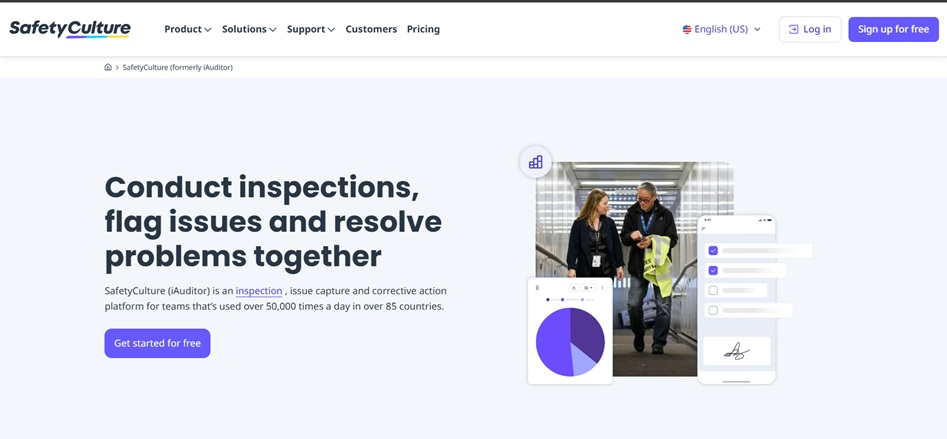
SafetyCulture has built something genuinely impressive for front-line inspection work. The mobile experience is the best in this category by a clear margin and auditors can conduct inspections on a phone or tablet, attach photos directly to findings, and complete checklists offline with data syncing when connectivity returns.
For high-volume, frequent inspection programs, daily hygiene checks, shift-start walkthroughs, vehicle inspections, iAuditor is extremely well-suited. The template library is massive, the learning curve is low, and the per-user pricing is accessible.
MasterControl
MasterControl is the dominant platform in heavily regulated life sciences environments, pharmaceutical, biotech, and medical device manufacturing, and its audit module reflects that.
The electronic signature functionality, validation documentation, and audit trail integrity in MasterControl are genuinely best-in-class for those environments. If your quality system demands validated software with complete electronic records, MasterControl is one of a short list of options that can actually deliver it.
If you manufacture consumer goods, food products, nutraceuticals, cosmetics, or specialty chemicals without the validation requirements of a life sciences environment, you're paying for capability you will never use.
Intellect QMS

Intellect positions itself around the flexibility of its no-code platform builder, and that positioning is legitimate. Quality teams with the patience and process design skills to configure it can build highly customized audit workflows, forms, and reporting dashboards without developer involvement.
The trade-off is that this flexibility often requires more initial configuration before the audit program is fully operational. Because the platform is designed to be highly adaptable, many organizations spend additional time tailoring workflows and forms to match their internal processes. Another consideration is that the platform does not come with manufacturer-specific audit configurations pre-built out of the box. While these workflows can certainly be created within the system, teams should plan for some setup time to align the platform with their operational and compliance requirements.
QT9 QMS
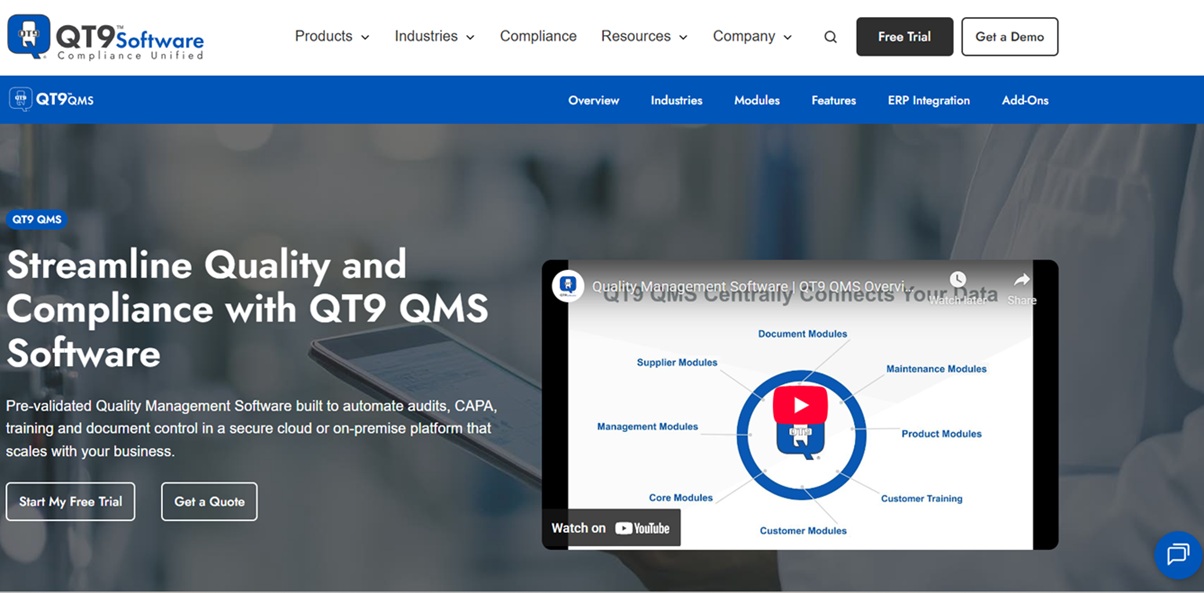
QT9 is the honest answer for a small manufacturer who knows they need to get off spreadsheets, has a limited budget, and doesn't need AI capabilities or advanced analytics. It covers the basics of audit scheduling, checklist management, finding tracking, and NCR logging. It integrates with other modules in the QT9 suite. It works.
What you may not find in QT9 are advanced capabilities like predictive analytics, AI-assisted checklists, or deeper cross-cycle trend reporting that some modern platforms are beginning to offer.
How to Choose the Right Audit Management Software
The question you could ask before evaluating any of these platforms isn't "which has the most features?" It's what does your audit program look like in twelve months, and which of these tools will make that realistic to run?
If you're a product manufacturer, food, nutraceutical, cosmetic, chemical, contract packaging, and you want to run a structured internal audit program with real NCR tracking, closed-loop CAPA, supplier audit capability, and reporting that tells you something useful, the conversation should start with QualSmart.ai. It's built for that environment, you can be live within weeks, and the AI-assisted functionality is genuinely useful in day-to-day quality work rather than being a marketing checkbox. It is composed of 18 plus modules for all QMS requirements in an organisation.
Manufacturers typically need more than just digital checklists. A practical audit platform should support structured internal audits, non-conformance tracking, closed-loop CAPA management, supplier audits, and reporting that helps teams identify recurring issues rather than simply generating reports.
Some enterprise platforms are designed for organizations managing complex, multi-site quality systems with dedicated implementation resources. Others focus primarily on mobile inspections or basic checklist execution.
For many product manufacturers in food, nutraceuticals, cosmetics, chemicals, and contract manufacturing, the priority is usually a system that balances structured audit management with usability and a realistic implementation timeline. Platforms designed specifically for manufacturing environments tend to deliver that balance more effectively, particularly when they combine audit scheduling, NCR tracking, and CAPA workflows in a single system.
Ultimately, the right choice depends on the scale of your operation, the complexity of your audit program, and how quickly your quality team needs to move from spreadsheets to a structured digital system.
Bottom Line
Internal audit management software is one of those purchases where the gap between the right choice and the wrong choice shows up slowly, then all at once, usually when you're sitting across from an external auditor who's asking where your open NCR closure records are.
The best audit software isn't the one with the most impressive enterprise demo. It's the one your quality team actually uses, consistently, audit after audit, because it makes their work easier rather than adding another system to manage.
Curious how QualSmart.ai handles your specific audit types and facility setup? Book a 30-minute walkthrough, we'll show you exactly how your audit program would work on the platform before you commit to anything.
